- Article
-

- AI & ML Training
- The Skills That AI Can Do Has Increased and Most People Don’t Know They’re Falling Behind
The Skills That AI Can Do Has Increased and Most People Don’t Know They’re Falling Behind
AI Skill Gap—Written by Dharani Harika (Works with TechBaton as Content Curator)

Arun Chauhan
Updated: July 28, 2026
Published: March 21, 2026
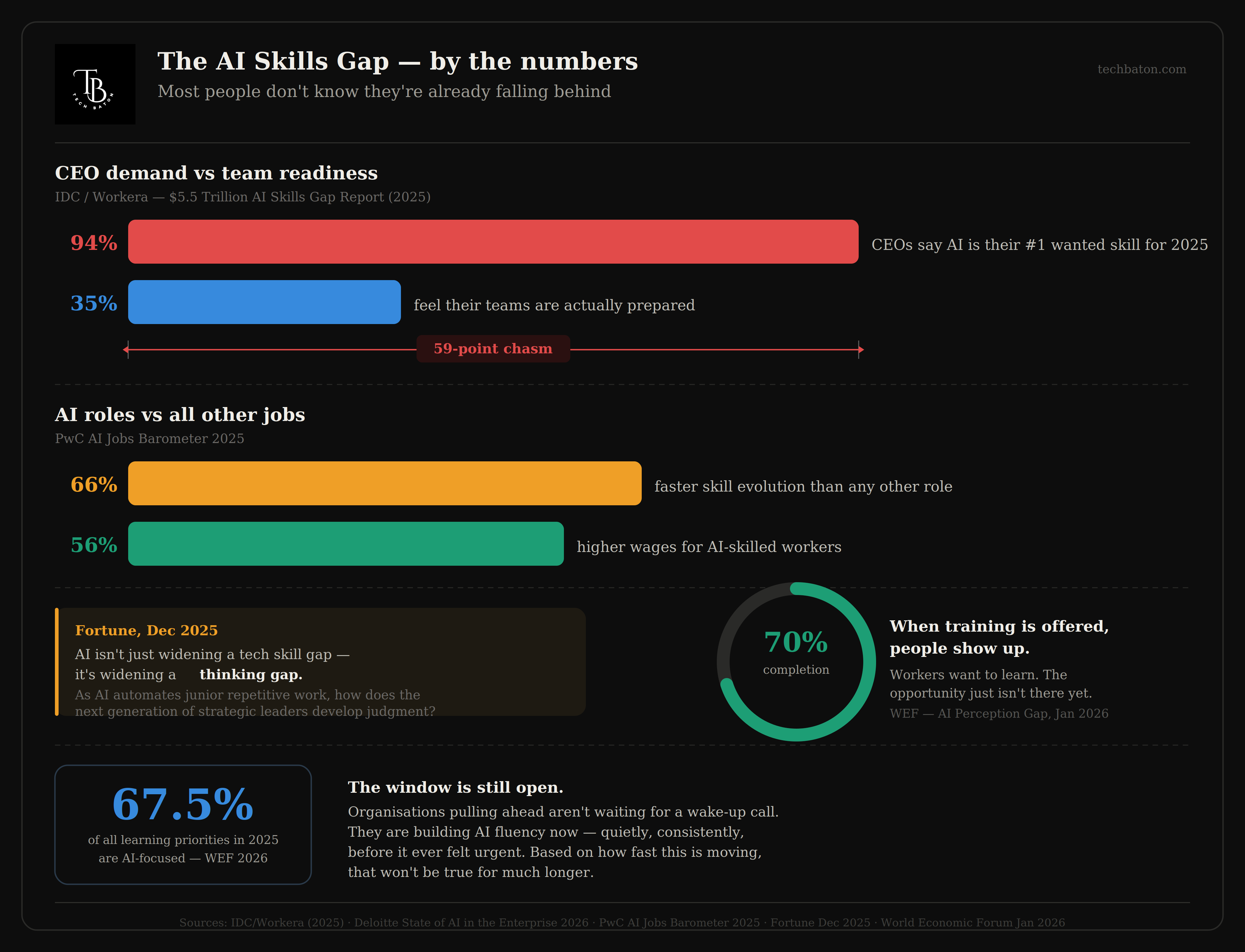
94% of CEOs say that AI is their most wanted skill for 2026, yet only 35% feel that their teams are actually prepared for it. That’s not a small mismatch. That’s a huge problem happening in slow motion.
→ IDC Report via Workera — The $5.5 Trillion Skills Gap
THE GAP IS WIDER THAN YOU THINK
According to Deloitte’s 2026 statement and report about AI in the Enterprise section, worker skills that are insufficient are now the number one barrier to AI process,es ahead of cost, technology, or strategy.
PwC’s AI Jobs Barometer says that the roles that require AI skills are evolving 66% faster than any other jobs. Workers with skills like these already earn 56% more than others.And yet only a small number of employees received AI training in the past year.
→ Deloitte — State of AI in the Enterprise 2026
→ PwC — 2025 Global AI Jobs Barometer (via Gloat)
IT'S NOT JUST A TECHNICAL PROBLEM
Fortune had stated something that organizations and companies are secretly worried about: AI isn’t just widening a tech skill gap with people; it’s also widening a thinking gap between them.
As AI takes over repetitive input work, the normal way of growing deep skills in your domain is breaking down concepts and learning what they really are. The junior employee doing repetitive work is used to build judgment over time. At the moment, this work is automated through AI. So, from where does the next generation of strategic leaders come from?
This is a question nobody has an answer to yet.
→ Fortune — The AI Skills Gap Is Really a Critical Thinking Gap (Dec 2025)
THE GOOD NEWS: AWARENESS IS NOT THE BARRIER
The World Economic Forum’s research found that by providing structured AI training, 70% of workers complete the task. People want to learn new things. They’re just not getting the opportunity to do so.
As of early 2026, AI represents 67.5% of all learning priorities across industries surveyed by WEF. The demand is still there. The result of good training is still catching up.
→ World Economic Forum — The AI Perception Gap (Jan 2026)
WHAT THIS MEANS
The organizations that are pulling ahead are not waiting for a wake-up call. They are building AI fluency now, quietly, consistently, and before it ever felt urgent. They are not making headlines about it. They are simply showing up, learning the right things, and compounding that over time. The window is still open for you to get ahead. But based on how fast this space is moving, that won't be true for very long.
Sources used in this post:
- IDC / Workera — $5.5 Trillion AI Skills Gap report (2025)
- Deloitte — State of AI in the Enterprise 2026
- PwC — 2025 Global AI Jobs Barometer
- Fortune — “The AI Skills Gap is Really a Critical Thinking Gap” (Dec 2025)
- World Economic Forum — AI Perception Gap report (Jan 2026)